
Seller Concessions: How They Work, Limits and Examples

A seller concession is an agreement in the purchase contract that the seller pays certain costs of the buyer’s purchase, usually closing costs, so the buyer needs less cash on closing day. The amount is capped by the buyer’s loan program, it can never pay the down payment, and it works best when both sides understand the numbers before they negotiate. If you are buying with limited savings, we also help with down payment and closing cost assistance, and the sections below show where concessions fit alongside it.
TL;DR
- A concession is a seller-paid credit toward the buyer’s costs, written into the purchase agreement as a percentage of the price or a fixed dollar amount.
- Limits come from the loan: conventional 3%, 6% or 9% depending on down payment, FHA 6%, USDA 6%, and VA 4% for VA-defined concessions.
- Concessions cannot be used for the down payment on any loan type, and a credit larger than the buyer’s real eligible costs is forfeited, not paid out as cash.
- For sellers, a credit can protect the sale price on the record while still closing the deal.
- Redfin reported concessions in 44.7% of U.S. home sales in August 2026, so asking is normal in many markets.
Table of Contents
- What seller concessions are
- What a seller can pay for
- Seller concession limits by loan type
- A worked example
- How much is typical?
- Why a seller might agree
- How to ask for concessions as a buyer
- Investors and trustees
- Where we come in
- Our perspective
- FAQ
- Sources
What seller concessions are
The National Association of Realtors describes a concession as the seller paying certain costs associated with purchasing a home on the buyer’s behalf. The same guide lists title search, loan origination, inspection, HOA fees, real estate taxes, home repairs and updates, and fees for agents and appraisers as examples.
The terms you will hear mean the same thing in practice: seller concessions, seller credits, seller-paid closing costs. They are negotiated as part of the purchase agreement, and the amount can be a percentage of the purchase price or a fixed dollar figure.
One point that surprises many first-time buyers: the money is not a gift out of nowhere. The Consumer Financial Protection Bureau explains that buyers generally pay all transaction costs, but may negotiate a seller credit toward closing costs, usually in exchange for a higher purchase price. The buyer still pays the cost, but through the loan rather than out of pocket. That is exactly why concessions help buyers who have enough income for the monthly payment but not enough cash on hand.
What a seller can pay for
Closing costs are the fees due when the sale completes: lender charges, title and escrow work, recording fees and prepaids. Prepaids are items such as property taxes, homeowners insurance and interest paid in advance. Reporting from September 2026 notes that concessions can cover loan origination charges, discount points, title insurance, escrow fees, recording charges, prepaid taxes and insurance, and approved rate buydowns. A rate buydown is money paid up front to lower the interest rate for a set period or for the life of the loan.
Fannie Mae’s rules allow financing concessions on a conventional loan to cover borrower closing costs including prepaids and up to 12 months of post-settlement HOA assessments.
What a seller cannot pay for
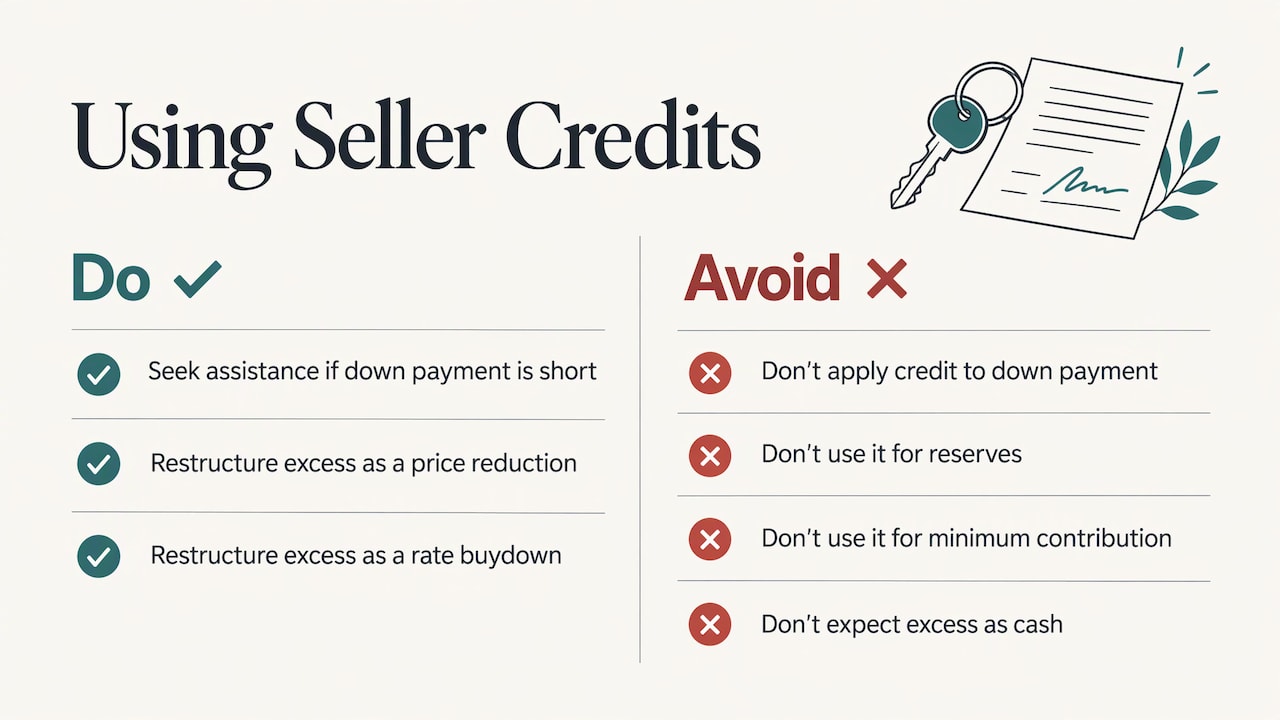
The firm rule: Fannie Mae prohibits these contributions from being used for the borrower’s down payment, financial reserves or minimum borrower contribution. FHA works the same way: the credit may not satisfy the borrower’s minimum required investment, which is the 3.5% down payment. If you are short on the down payment itself, a price reduction or a separate assistance program is the tool, not a concession.
A credit also has a ceiling set by your actual bills. Per the September 2026 Inman report, a credit larger than the buyer’s real closing costs is forfeited rather than paid out as cash, and should be restructured as a price reduction or a rate buydown.
Seller concession limits by loan type
The cap is set by the lender’s program, and state law can add its own rules. The limits below are the published program rules; confirm the exact figure with your loan officer before you write an offer.
| Loan type | Cap on seller contributions | Based on |
|---|---|---|
| Conventional, over 90% LTV | 3% | Lower of price or appraised value |
| Conventional, 75.01% to 90% LTV | 6% | Lower of price or appraised value |
| Conventional, 75% LTV or less | 9% | Lower of price or appraised value |
| Conventional, investment property | 2% | Lower of price or appraised value |
| FHA | 6% | Sales price |
| VA | 4% for VA-defined concessions | Reasonable value |
| USDA | 6% | Sales price |
The conventional tiers come from Fannie Mae’s Selling Guide (version effective May 7, 2025). LTV, or loan-to-value, is the loan balance divided by the home’s value, so a 5% down payment means a 95% LTV and the 3% tier. A mortgage lender’s March 2026 summary confirms the FHA, VA and USDA figures, and adds that jumbo and portfolio loans vary by lender with no single limit.
Two details are worth knowing:
- FHA. The 6% limit comes from HUD Handbook 4000.1. Contributions above 6% or above actual costs are treated as an inducement to purchase and reduce the price used for the loan.
- VA. The 4% cap applies to VA-defined concessions such as the funding fee, prepaid taxes or insurance, extra discount points and certain debt payoffs. Sellers may contribute toward some or all of the buyer’s ordinary closing costs outside that cap. On a $400,000 reasonable value, the cap works out to $16,000.
On commissions, HUD’s handbook treats seller-paid real estate agent commissions under local law or custom as not an interested party contribution. NAR’s guide adds that any payment toward a buyer’s broker fee is excluded from lender-set limits and must be made off the MLS. Concessions advertised on an MLS must be written as the total sum of all concessions and cannot be conditioned on payment to a buyer’s agent. Our guide to buyer agent fees covers who pays what on that side.
A worked example
Take a $400,000 purchase with 10% down ($40,000) and $12,000 in eligible closing costs and prepaids. A lender’s March 2026 example shows that a $10,000 seller credit lowers the cash the buyer needs from $52,000 to $42,000 without changing the purchase price, the down payment or the original mortgage amount.
Now check the limit. At 10% down the conventional LTV is 90%, which falls in the 6% tier. Six percent of $400,000 is $24,000, so a $10,000 credit is within the cap. It is also below the $12,000 of eligible costs, so every dollar gets used.
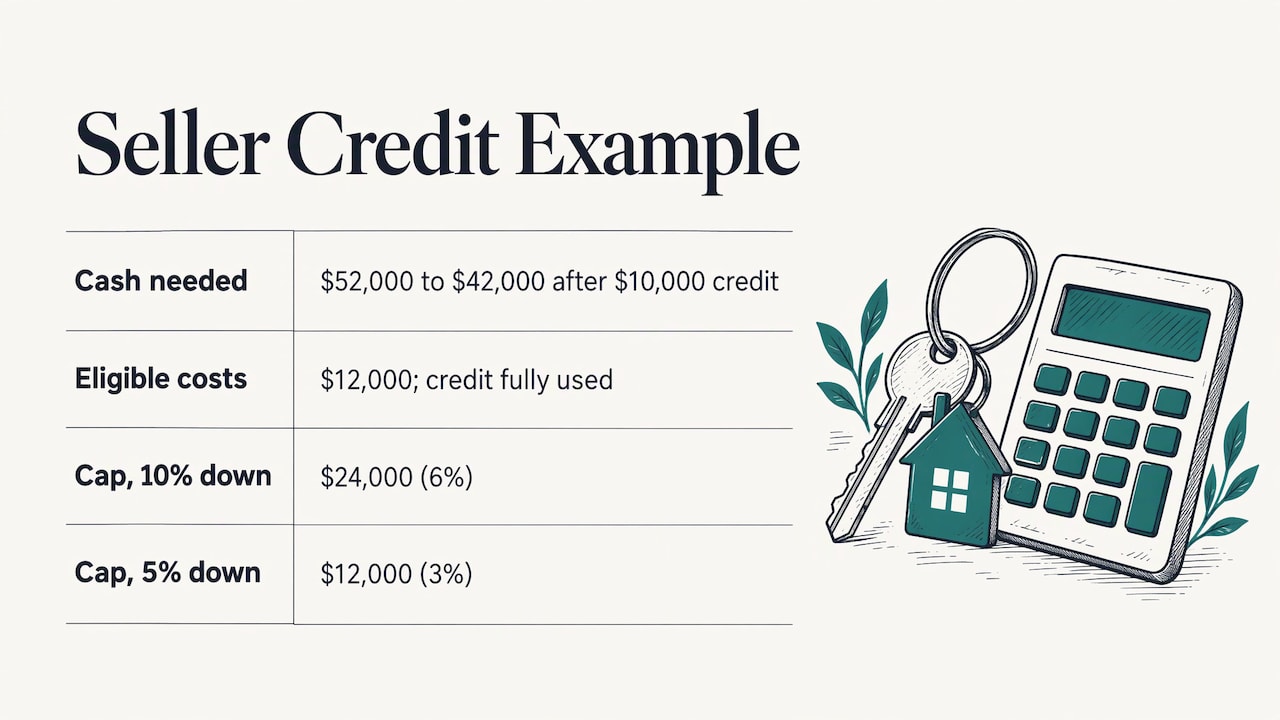
Change one thing: the buyer puts down 5%. The cap drops to 3%, or $12,000, and the credit still fits. A $15,000 credit would not. Program maximums are not automatic credits. The loan program, occupancy, down payment, appraisal, contract and the buyer’s actual eligible costs all decide the usable amount, so ask for what your costs justify rather than the ceiling.
How much is typical?
There is no standard percentage. What you can see is how often concessions happen: Redfin reported them in 44.7% of U.S. home sales in August 2026, up from 42.6% a year earlier, with 15.8% of sales combining a concession with a price cut. Redfin publishes this on rolling three-month periods and updates it monthly, so check its latest release for the current share.
The amount depends on your market and your loan. Your real ceiling is the lower of your loan’s cap and your actual eligible closing costs, and a number you can justify line by line is easier for a seller to accept.
Why a seller might agree
For the seller, a concession can make a property more attractive to buyers or lead to a better or faster offer. It also keeps the price intact. Inman’s reporting frames it this way: a $5,000 credit solves a buyer’s cash problem without the signal a $5,000 price cut sends, and protects the comparable sale that neighbors’ appraisals will later lean on.
Before accepting, a seller should know their net. Compare the offer’s price minus the credit, commissions and other costs against a competing offer. Our breakdown of the cost to sell a house lays out the line items, and the home selling FAQ answers the common offer questions.
How to ask for concessions as a buyer
- Get your loan estimate first. Your lender lists closing costs and prepaids. That total is your ceiling, and it tells you what you can justify asking for.
- Confirm your cap. Match your loan type and down payment to the table above. Your loan officer can tell you the exact figure for your file.
- Choose the form. A dollar amount is simplest. A percentage works too, but it must stay inside the cap once the appraisal arrives.
- Put it in the offer. Concessions are written into the purchase agreement, so they compete with price, timing and contingencies. In a slow market a credit may be easy to win. In a hot one, a clean offer with a smaller ask is stronger.
- Watch the appraisal. Caps are tied to the lower of price or appraised value on conventional loans, and to reasonable value on VA loans.
- Consider a rate buydown. If your costs are lower than the credit, ask whether the extra can buy down your rate rather than being lost.
FHA gives a minimum-down buyer twice the concession room of a conventional buyer in the same position, though the credit still cannot cover the 3.5% minimum investment. For the down payment, see our guide to no down payment home loans. Buyers in Washington can start with our overview of first-time buyer programs.
Investors and trustees
Investors should note the 2% conventional cap on investment properties, so a concession is a small lever there. Price and terms usually matter more to your return. Trustees selling an estate property will mostly meet concessions as a request from the buyer, so the net-to-estate math above applies, and our trust services page describes the support we offer on those transactions.
Where we come in
Concessions are one tool for lowering what a buyer needs at closing. Real Simple Housing is a brokerage serving California, Colorado, Washington and Wyoming, and we offer down payment and closing cost assistance programs for buyers, low-fee listings for sellers, and personalized guidance through the offer. You can see the full list on our buying and selling page.

If you are selling and want a quick sale, our Cash Offers Now program is another route. Questions about buying are collected in our home buying FAQ.
Our perspective
Most first-time buyers we talk to are not short on income. They are short on cash at closing, and they hear “seller concessions” as if it were a magic word. It is a useful tool with clear edges: it covers costs, never the down payment, and it has a cap set by the loan.
That is why we pair the negotiation with the other pieces. Down payment and closing cost assistance is part of what we offer, and our low-fee listings are meant to leave sellers more room in their net, which makes a fair credit easier to agree to. A concession should be one line in a plan you understand, with every number on the table before you sign.
For sellers and trustees the same discipline applies. Know your net, compare offers on the bottom line rather than the headline price, and take the time to get it right.
Justin
FAQ
Who pays seller concessions?
The seller agrees to them in the contract, and they are credited to the buyer at closing. In practice the buyer often covers them indirectly, because a credit is usually traded for a higher purchase price. The seller’s proceeds drop by the credit amount.
What is the 4% seller concession rule?
It is the VA loan cap: VA-defined concessions such as the funding fee, prepaid taxes or insurance, and extra discount points can total no more than 4% of the home’s reasonable value. Sellers may also pay the buyer’s ordinary closing costs outside that cap, per the VA program summary.
Can seller concessions pay my down payment?
No. On conventional loans the rules bar these contributions from the down payment, and FHA bars them from the 3.5% minimum investment. A lender guide for 2026 says the same applies to every loan type.
What happens if the credit is bigger than my closing costs?
The excess is lost. It is not paid to you as cash. Under Fannie Mae rules, financing concessions over the limit are reclassified as sales concessions and deducted from the sales price, which can change the LTV. Ask your lender to size the credit to your costs.
Sources
- NAR Consumer Guide: Seller Concessions
- NAR: What Are Seller Concessions?
- CFPB: What fees are paid when closing on a mortgage
- Fannie Mae Selling Guide: Interested Party Contributions
- Inman: Seller Concessions Explained
- Seller concession limits by loan type (March 2026)
- Lender limits on seller credits
- Seller concession guide for realtors
- Conventional, FHA, VA and USDA loan limits
- Maximum seller concessions by loan type, 2026
- Seller concessions reach 44.7% of home sales