Getting a Mortgage With a Low Credit Score: What Works
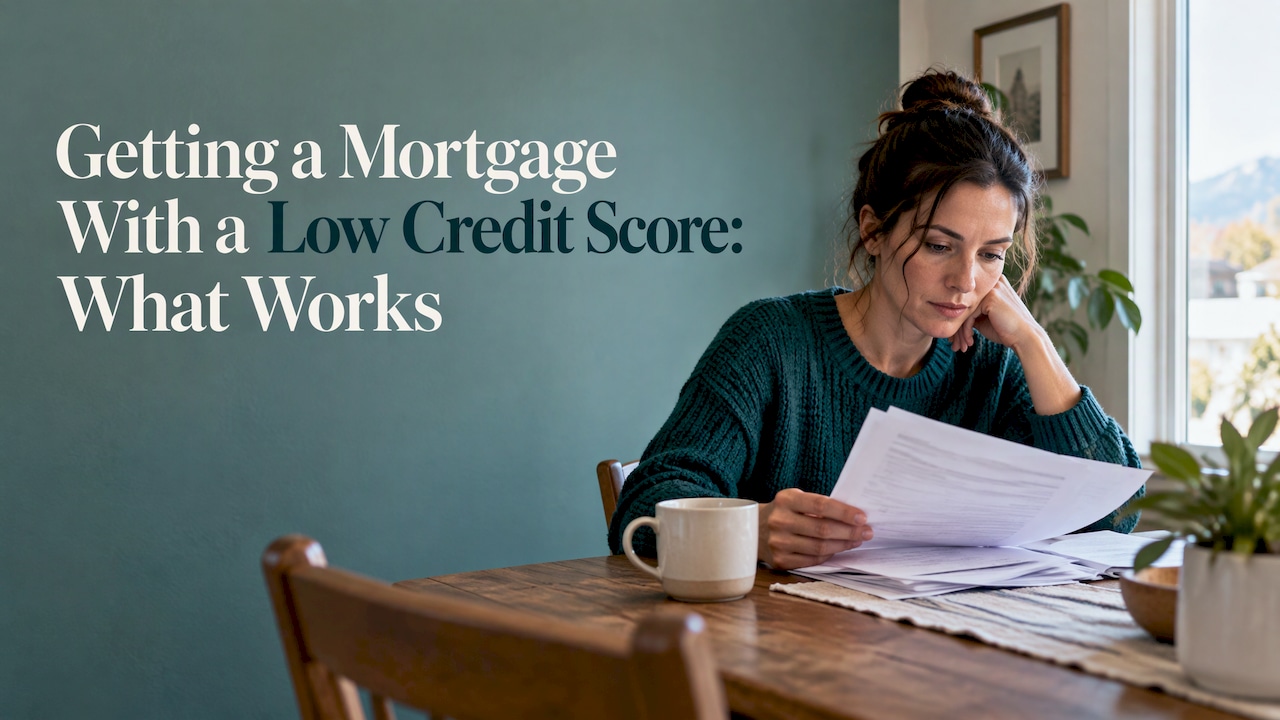
Yes, you can get a mortgage with a low credit score. FHA loans accept scores as low as 500 with a larger down payment, and lenders weigh income, savings and debt alongside the score. What changes is the price: a lower score means a higher rate, more mortgage insurance and a bigger cash requirement. The buyers who do best plan around those costs before they apply. We help buyers do that in California, Colorado, Washington and Wyoming, including through down payment and closing cost assistance programs.
TL;DR
- FHA is the most open door: a 580 score qualifies for 3.5% down, and 500 to 579 requires 10% down. Below 500 is not eligible.
- Conventional loans can still work below 620. Fannie Mae’s automated underwriting has no minimum score, though many lenders set their own floor.
- A low score costs you in rate and insurance, so compare the total monthly payment on each program, not just the rate.
- Strengthen the file with on-time rent history, cash reserves and a lower debt load before you apply.
- Buying a rental with weak credit is harder: investment loans ask for bigger down payments and higher scores, and FHA requires you to live in the home.
Table of Contents
- What lenders look at besides your score
- Minimum scores by loan program
- What a low score costs you
- Mortgage insurance in plain terms
- How borrowers under 620 get approved
- Strengthen your file before you apply
- Budget for the cash, not just the down payment
- Buying a rental property with bad credit
- Where we come in
- Our perspective
- FAQ
- Sources
What lenders look at besides your score
Your score is one input. Most mortgage lenders pull FICO scores from all three credit bureaus (Equifax, Experian and TransUnion) and use the middle score to set your rate. The same page lists the other factors: your credit history, existing debt, savings, total assets and current income.
Two ratios matter most. Debt-to-income (DTI) is your monthly debt payments divided by your gross monthly income. Loan-to-value (LTV) is the loan amount divided by the home’s value, so a bigger down payment lowers it. Lenders assess credit, DTI, LTV and assets together, which is why a borrower with a thin score can still be approved by showing a larger down payment, more cash reserves or a lower DTI.
Minimum scores by loan program
The numbers below are program rules. Individual lenders can add their own stricter requirements, so the lender you apply with may ask for more.
| Program | Score and down payment | What to know |
|---|---|---|
| FHA | 580+ with 3.5% down; 500 to 579 with 10% down; below 500 not eligible | Mortgage insurance on every loan, but often the cheapest route for lower scores |
| Conventional (Fannie Mae) | Manually underwritten: 620 fixed-rate, 640 ARM; automated DU: no minimum | Many lenders still apply their own floor, often 620 |
| VA | No official minimum | Most lenders want about 620; no down payment for eligible borrowers |
| USDA | No official minimum | Most lenders want about 620; income limits apply, no down payment |
The FHA tiers and the USDA and VA lender norms are summarized in this program comparison. In October 2026 FHFA noted that Fannie Mae and Freddie Mac opened VantageScore 4.0 to all approved lenders, with Classic FICO still approved. Which scoring model your lender uses can change your number, so ask which one they pull.
FHA also has a citizenship and residency rule: since Mortgagee Letter 2025-09, non-permanent residents are no longer eligible for case numbers assigned on or after May 25, 2025.
What a low score costs you
The CFPB describes the pattern: scores in the mid to high 700s get the lowest rates, scores from 620 to 680 generally pay the highest rates with the fewest choices, and below 620 qualifying gets harder. FHA, VA and USDA programs may still be open to you in that range.
Here is what that looks like in dollars:
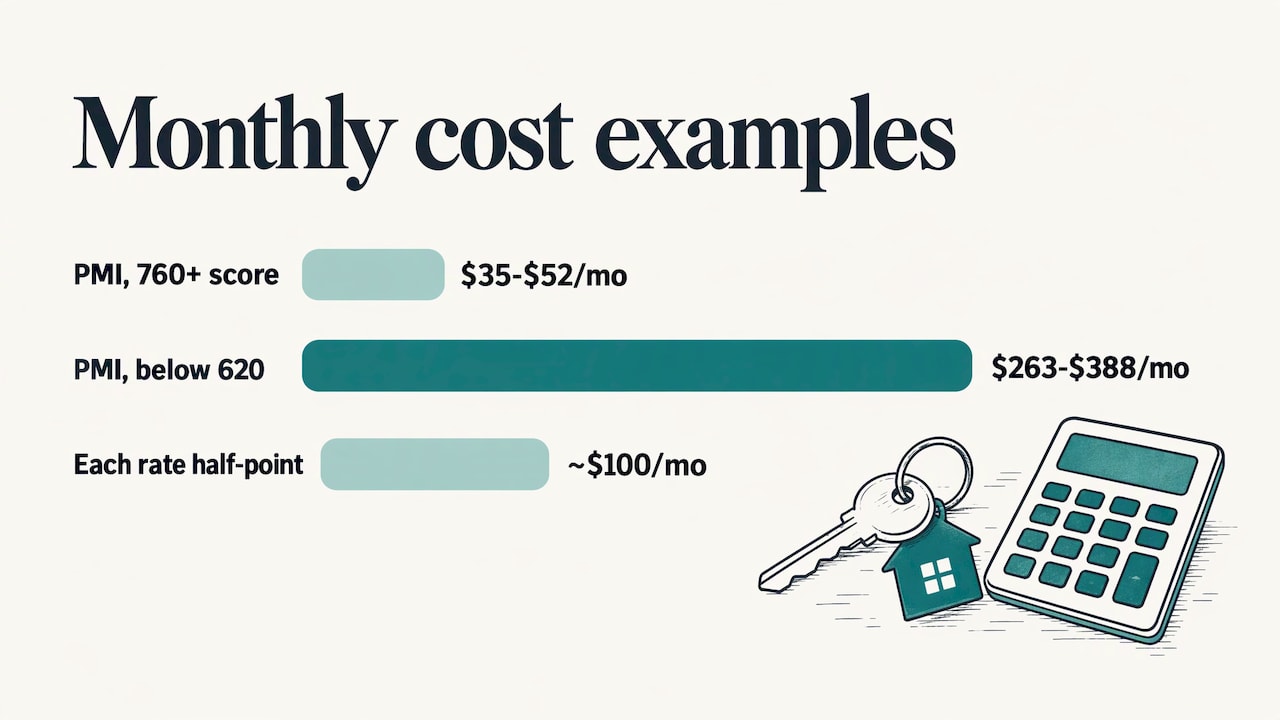
- Rate: on a $300,000 30-year loan, each half-point of rate adds about $100 a month, or about $36,000 over 30 years, according to one bank’s guide.
- Down payment: on a $250,000 home, 3.5% down is $8,750 and 10% down is $25,000. That gap is why crossing 580 matters so much.
- Conventional PMI: private mortgage insurance on a $250,000 loan with 5% down runs about $35 to $52 a month at 760+ credit and about $263 to $388 a month below 620, based on September 2026 rate data from three insurers.
Rates and insurance pricing move with the market and with insurer updates, so treat these as illustrations and compare live quotes.
Mortgage insurance in plain terms
Mortgage insurance is paid by you but protects the lender if you stop paying. It is not life insurance or homeowners insurance. Lenders may require it when your down payment is under 20%. According to the HUD housing counselor training guide:
- Conventional PMI typically runs 0.5% to 1.5% of the loan per year. It ends automatically at 78% LTV, and you can request removal at 80%.
- FHA charges 1.75% upfront plus 0.50% to 0.75% a year.
- VA charges a one-time funding fee of 1.25% to 3.3%, and USDA a 1% guarantee fee plus 0.35% a year.
FHA insurance is priced by loan amount, LTV and location, not by credit score, so the premium is the same at 580 as at 780. With less than 10% down it generally lasts the life of the loan; with 10% or more down it ends after 11 years, per a 2026 FHA insurance guide. Because conventional PMI climbs steeply as scores fall, the CFPB advises that FHA can often be the cheapest option for lower scores or smaller down payments, and suggests getting quotes for both and comparing total cost.
How borrowers under 620 get approved
Many sub-620 FHA borrowers are approved through manual underwriting, where a person reviews the file instead of relying only on the automated score. A “refer” result from FHA’s automated scorecard is not a denial. HUD’s handbook lets underwriters weigh compensating factors, as one bank’s guide explains:
- 12 or more months of on-time rent, often the strongest factor for renters
- Cash reserves left after closing
- A low DTI
- Stable employment, often two years in the same job or field
For FHA scores of 580 to 619, a housing expense ratio of 38% or lower and DTI under 45% is the target, while 620+ can qualify with DTI up to 57%. Print your rent payment history and bank statements before you talk to a lender; those documents carry the file.
Strengthen your file before you apply
If you are not buying for at least six months, the CFPB says improving your credit can save $50 to $100 on a typical monthly payment. The same toolkit gives the levers:
- Pay on time, every time. Payment history is about 35% of a score, and the amount you owe is about 30%.
- Check your reports for errors. Correcting mistakes can lift scores in 30 days or less.
- Pay down card balances. Habits like this can show up in a score within three months or more.
- Do not finance anything new. Even a new refrigerator on credit before closing can make approval harder.
- Shop lenders in a short window. Comparing mortgage offers within 14 to 45 days generally has little or no effect on your scores.
Be wary of anyone charging upfront fees to “fix” your credit; the CFPB says those are often scams. Lenders also check that your paperwork matches your story, so assemble consistent application documents early: pay stubs, tax returns, bank statements and ID that agree with each other. Our guide to getting approved for a mortgage walks through the full sequence, and if a past foreclosure is part of your credit story, see buying a home after foreclosure for the waiting periods.
Budget for the cash, not just the down payment
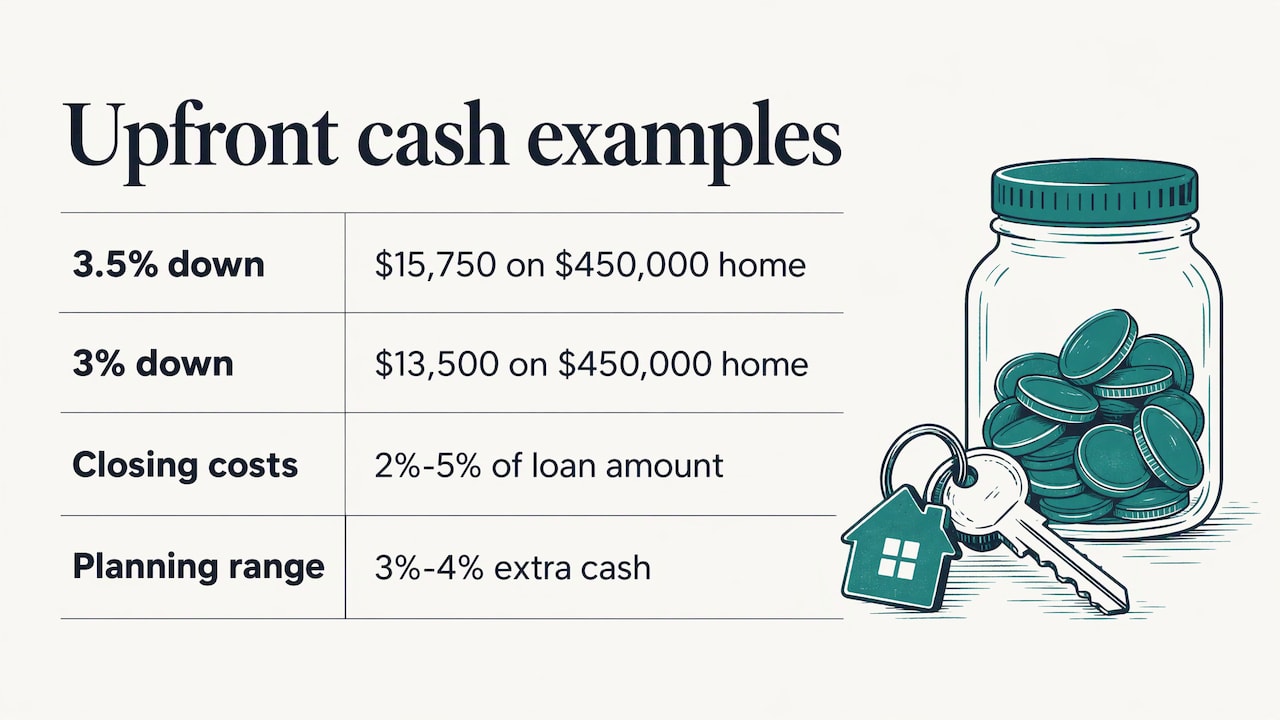
Closing costs typically add 2% to 5% of the loan amount, so plan for roughly 3% to 4% extra in cash, according to a first-time buyer guide. On a $450,000 home, 3.5% down is $15,750 and 3% down is $13,500, before closing costs. For a low-score buyer this is the real hurdle, since the score is only part of what stands between you and the keys.
That is where assistance programs earn their place. We offer down payment and closing cost assistance programs for buyers in our four states. Local programs differ by state and county, so start with the one that matches where you want to live: Washington, Colorado or Los Angeles County. If you are still building savings, our down payment saving plan and the overview of no down payment home loans show the other routes.
Buying a rental property with bad credit
Investors with weak credit face a steeper climb. Lenders see rentals as riskier, because borrowers in trouble are more likely to default on a rental than on their own home, so they ask for more:
- Down payment and score: Fannie Mae’s matrix caps investment LTV at 85% for a one-unit property (15% down) and 75% for two to four units (25% down). For manually underwritten loans it sets a minimum of 680 for one unit above 75% LTV, with six months of reserves.
- Rate: often 0.5% to 0.75% above primary-residence rates.
- Income: lenders typically count only 75% of expected rent, and want two years of tax returns and W-2s plus two months of bank statements, per this investment loan guide.
The lower-score route is the owner-occupied multi-unit. FHA may finance a two- to four-unit home with 3.5% down at 580+ if you live in one unit for at least a year, as NerdWallet explains. Experian’s multi-unit guide notes that FHA two- to four-unit loans may qualify at 500 to 579 with up to 10% down. If you are building a portfolio from another state, our investor team offers property acquisition and analysis and out-of-state investor support.
Where we come in
A mortgage approval is only half of buying; the other half is finding a home and a deal that fit the loan you can get. We are a brokerage serving California, Colorado, Washington and Wyoming, with personalized guidance for first-time buyers and down payment and closing cost assistance programs designed to make homeownership more accessible. Explore buying a home with us and see which assistance programs apply to your situation.

Our home buying FAQ answers the most common first-timer questions.
Our perspective
A low score is a pricing problem before it is a yes-or-no problem. Most of the buyers we talk to assume the answer is no, when the real question is which program fits and how much cash it takes.
Our approach is to keep costs down and the guidance personal. That means looking at the whole purchase: the down payment, the closing costs, the monthly payment with mortgage insurance, and whether assistance can cover part of the gap. Our down payment and closing cost assistance programs exist because cash, not credit, is often what stops people.
If you are close to a threshold such as 580, a few months of on-time payments and lower balances can change your options. If you are ready now, bring your rent history and bank statements and we will work through the numbers with you.
Justin
FAQ
What is the lowest credit score you can buy a house with?
FHA loans accept a score of 500 if you put 10% down, and 580 if you put 3.5% down. Below 500 is not eligible for FHA. Some lenders set higher minimums than the program, often 620 for conventional, VA and USDA loans.
How much is the down payment with bad credit?
On FHA it is 3.5% at 580 or higher and 10% at 500 to 579. On a $250,000 home that is $8,750 versus $25,000. Plan for closing costs of roughly 2% to 5% of the loan on top.
Will I have to pay mortgage insurance?
Likely, if you put less than 20% down. FHA requires it on every loan, and with less than 10% down it generally lasts the life of the loan. Conventional PMI can be removed once you reach 78% to 80% LTV.
Can I buy a rental property with a low credit score?
It is harder than buying a home to live in. Investment loans typically need 15% to 25% down, higher scores, reserves and higher rates. Buying a two- to four-unit property you will live in, using FHA, is the usual lower-score route.
Sources
- Ask CFPB: credit score and mortgage rate
- Investopedia: How to get a mortgage with bad credit
- CFPB: FHA loans
- Fannie Mae Selling Guide: credit score requirements
- The Mortgage Reports: mortgage programs by minimum credit score
- FHFA: Credit scores
- Recent changes to FHA loan requirements
- CFPB: Get your money situation in order
- Herring Bank: buying a house with bad credit
- PMI rates chart 2026
- HUD Housing Counselors Training Module 2.2
- FHA mortgage insurance in 2026
- Rocket Mortgage: buying a house with bad credit
- CFPB: Your home loan toolkit
- Mortgage fraud red flags checklist
- The Mortgage Reports: first-time buyer down payment
- Investopedia: financing an investment property
- Fannie Mae Eligibility Matrix
- The Mortgage Reports: investment property loans
- NerdWallet: buying an investment property
- Experian: credit score for a multi-unit property