
How to Choose a Listing Agent and Get Your Home Ready to Sell

The right listing agent is the one who can show you a pricing method, a marketing plan and a written agreement you understand, at a fee you negotiated. The sale itself starts earlier, with how the house is prepared. At Real Simple Housing we work as a low-fee brokerage in California, Colorado, Washington and Wyoming, and our Speak With A Listing Agent page is where sellers start a conversation. This guide gives you the full process: how to compare agents, what the contract must say, and how to prepare the house.
TL;DR
- Interview at least two or three agents and ask each the same questions, starting with how they arrived at the suggested list price.
- Agent compensation is negotiable and not set by law, so compare fees together with services, never fees alone.
- Read the listing agreement for the asking price, the services, the fee and the start and end dates before you sign.
- Prepare the house before the first photo: repairs, cleaning, decluttering, curb appeal and a folder of warranties and manuals.
- Trustees and heirs selling an estate property need an agent who can coordinate valuation, cleanout and paperwork, not only list it.
Table of Contents
- What a listing agent actually does for you
- Who is selling decides what to look for
- Where to find agents worth interviewing
- The ten questions to ask every agent
- Compare pricing advice, not just the number
- Understand fees before you compare agents
- Read the listing agreement line by line
- How to get a house ready to sell
- A prep checklist you can print
- Selling for an estate or trust
- If you want a fast, no-prep sale
- Why sellers choose Real Simple Housing
- Our perspective
- FAQ
- Sources
What a listing agent actually does for you
A listing agent represents the seller. They advise on price, prepare and market the property, field showings and offers, and guide you through negotiation to closing. The National Association of REALTORS® (NAR) describes marketing as a mix that may include staging, professional photography, social media, signage, open houses and competitive pricing, and notes that MLS listings usually give the broadest buyer exposure. The MLS is the multiple listing service, the database local agents use to share listings.
So the choice is not a popularity contest. You are choosing the person who will set the price, control the exposure and negotiate on your behalf for the largest transaction many families make.
Who is selling decides what to look for
The core questions are the same for everyone, but the emphasis changes.
- Sellers watching costs: you want a clear, written fee and a plan that does not depend on a high commission to work. Low-fee listings exist for exactly this reason.
- First-time buyers who also need to sell: you need an agent who can line up the sale with your next purchase.
- Investors: you need someone who understands tenants, timing and tax treatment. Our guide on choosing an investment property realtor covers that case in detail.
- Trustees and heirs: you need coordination, patience and a person who handles the property while you handle the family and the legal side.
Where to find agents worth interviewing
Start with referrals from people who sold recently in your neighborhood, then look at who has recent listings near you on the major home sites and who holds open houses nearby. Check that the person holds a license in your state. NAR points out that agents must be licensed where the home is sold, and that local market knowledge is what helps build a strategy that resonates with local buyers. A Denver condo and a Spokane ranch house do not sell the same way, and an agent who has recently sold homes like yours on your side of town knows which buyers to reach.
Shortlist two or three agents. Fewer gives you nothing to compare, and more makes the decision harder without making it better.
The ten questions to ask every agent
NAR publishes a consumer guide with ten questions to ask a seller’s agent. Ask all of them, in the same order, so the answers line up. Here is what to listen for:
- Are you a REALTOR®? REALTORS® are bound by NAR’s Code of Ethics.
- What services can you provide? Get specifics: photography, showings, open houses, paperwork, coordination with the closing.
- Are you familiar with my market? Ask for homes they sold within the last year in your area.
- What is in the listing contract? Ask for a blank copy now, not at signing.
- How did you arrive at your suggested list price? A good answer cites recent comparable sales, not a hope.
- How will you market my home? Look for a plan specific to your property, not a template.
- How do I attract buyers? The answer should connect price, condition and exposure.
- What do I need to do to get the house ready? The agent should walk the house and give you a short list.
- How will you vet buyers? This matters for showings and for judging how strong an offer is.
- Do you have references? Call two of them.
Red flags worth noticing
Be wary of an agent who offers the highest price with no comparables behind it, who will not hand over the contract in advance, who gives vague marketing answers, or who is hard to reach during the interview. How they communicate before you hire them is the best preview you will get of how they communicate once you have.
Compare pricing advice, not just the number
Two agents may suggest prices tens of thousands of dollars apart. Ask each to show the three to five recent sales they relied on and explain the adjustments for size, condition and location. The agent whose logic you can follow and check is the better pick, even if their number is lower than you hoped. A price set too high usually costs you time on the market and then a reduction. A price set with evidence brings buyers in during the first weeks, when a listing gets its most attention.
NAR also suggests that holding the first open house the weekend after the home goes on the market can help maximize exposure, so ask each agent what their launch week looks like.
Understand fees before you compare agents
Compensation is negotiable. NAR’s guide states that agent compensation is fully negotiable and not set by law. Since the 2024 NAR settlement, offers of compensation to a buyer’s agent are handled in their own written terms, which makes it easier to see what you are paying for. Our article on buyer agent fees explains what you pay, who pays it and what to negotiate, and it is worth reading before your first interview.
When you compare quotes, put the fee next to the services. A lower fee with professional photos, MLS exposure and full paperwork support beats a higher fee with a thinner plan. A brokerage that prices listings low and still gives you personal guidance is built for sellers who care about what they keep at closing.
Read the listing agreement line by line
The Federal Trade Commission’s guide for sellers says a listing agreement should be in writing and include the asking price, what the broker will do and how much you will pay, and the start and end dates. It also says you may negotiate a termination clause. Check these points:
| What to check | What to look for |
|---|---|
| Asking price | Matches the price you agreed with the agent |
| Services | The marketing and support you were promised are written in |
| Fee | The rate or amount, and who pays what |
| Term | Start and end dates, and how long you are committed |
| Termination | A way out if the service falls short |
| Contract type | Exclusive right to sell or exclusive agency, and what each means for you |
In an exclusive right-to-sell contract, one broker is paid whoever finds the buyer. In an exclusive agency contract, one broker markets the home but you keep the right to sell it yourself without owing the commission. Ask the agent to explain which one is in front of you.
Before signing, take your own record of the home’s condition. Room-by-room timestamped records, such as digital inspection reports, show what the property looked like on a given day. That is useful when you later discuss repairs, disclosures or condition with a buyer or a trustee’s co-beneficiaries.
How to get a house ready to sell
Agents will ask this early, and buyers judge a house in the first seconds of a photo. NAR’s guide to preparing to sell gives a sound order of work.
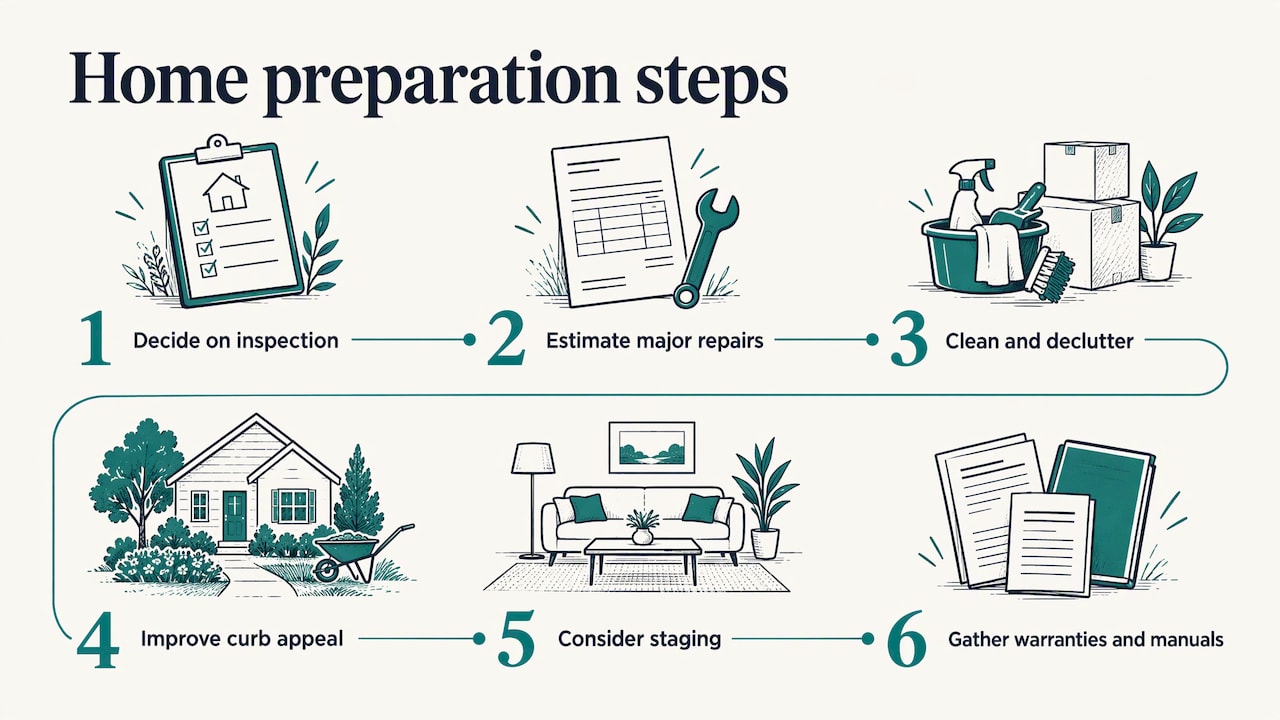
Step 1: Decide on a pre-sale inspection
A pre-sale inspection is not required, but it can show issues you may want to repair before showings. NAR says an inspector looks at structure, exterior, roof, plumbing, electrical, HVAC, interiors, ventilation and insulation, and fireplaces, and may test for mold, radon, lead paint and asbestos. If something turns up, talk to your agent about your state’s disclosure requirements. If you plan to sell without repairs, read our guide to selling a house as is.
Step 2: Get estimates for big repairs
NAR advises getting cost estimates for significant repairs. Roof, water damage, electrical and structural items come first, because buyers and their inspectors will find them. Decide with your agent whether to fix before listing or to price the home with the repair in mind.
Step 3: Clean and declutter
Clean windows, carpets, light fixtures and walls, and store clutter. Pack away personal items and extra furniture so rooms look larger. This is the cheapest work on the list and it shows in every photo.
Step 4: Improve curb appeal
The first photo and the drive-up impression are the exterior. Trim bushes, edge the lawn, add some plants, replace tired door hardware and repair visible driveway cracks, as Virginia REALTORS’ seller checklist suggests.

Step 5: Consider staging
NAR treats staging as optional. Ask each candidate agent whether they recommend it for your home, and whether a light version, such as rearranging furniture and adding lighting, would do the job.
Step 6: Gather warranties and manuals
Locate warranties, guarantees and manuals for the furnace, washer and dryer, dishwasher and any other appliance or system staying with the home. Put them in one folder with your repair receipts. It saves time during negotiation and makes the house look cared for.
A prep checklist you can print
- Decide on a pre-sale inspection and book it
- Collect estimates for roof, water, electrical or structural work
- Deep clean windows, carpets, walls and fixtures
- Remove clutter and personal items
- Trim, edge, plant and fix the front entrance
- Decide on staging with your agent
- Compile warranties, manuals and receipts
- Confirm your state’s disclosure requirements with your agent
Selling for an estate or trust
Trustees often carry the house and the family at once. The questions that matter most are who values the property, who clears it out, and who coordinates the closing. Our trust services cover valuation and preparation, personal property liquidation, transaction coordination, and assistance and guidance, with a concierge service program also listed. Details are on our trust services page. When you interview an agent for an estate sale, ask how they handle each of those steps and who is your single point of contact.
If you want a fast, no-prep sale
Some owners prefer to skip repairs and showings. Our Cash Offers Now program is built for that. You can read how it works on our sell my home page. It is one route among several, and the listing path above is the one to follow when you want to market the house to the open market.
Why sellers choose Real Simple Housing
We are a multi-state brokerage that focuses on lower-cost listings and personalized guidance, serving sellers, first-time buyers, investors and trustees in California, Colorado, Washington and Wyoming. If you are weighing agents, you can see how we work on why sell with Real Simple Housing, read our home selling FAQ, or look at our residential services, which include low-fee listings and down payment and closing cost assistance for your next purchase.

Our perspective
Most sellers pick an agent on a gut feeling and a logo on a sign. The ones who do best pick on evidence: a price they can explain, a marketing plan written down and a contract they have read twice.
We built Real Simple Housing around the idea that selling should cost you less and still come with real guidance. That means a low-fee listing, an agent who walks the house with you and tells you what to fix first, and a clear sense of what happens on each day of the sale.
For trustees, it means patience. An estate sale is slow in the places where families need time and fast in the places where paperwork is due, and our job is to keep both moving.
Whoever you hire, ask the ten questions, read the agreement and prepare the house. Do those three things and you will sell on better terms.
Justin
FAQ
How many listing agents should I interview?
Two or three is enough. Ask each the same ten questions, request a blank listing agreement and compare the pricing logic, the marketing plan and the fee side by side. More interviews rarely add information.
Is the agent’s commission negotiable?
Yes. NAR’s consumer guide states that compensation is fully negotiable and not set by law. Compare the fee together with the services written into the contract, since a lower rate with fewer services may not leave you better off.
Do I need a pre-sale inspection?
It is not required. It can show problems before buyers’ inspectors do, giving you time to repair them or to price around them. If it finds issues, talk with your agent about your state’s disclosure rules before you list.
How long should a listing agreement last?
The FTC’s guide says the contract should state its start and end dates, and that you may negotiate a termination clause. Agree on a term you are comfortable with, and make sure the way out is written down before you sign.
Sources
- NAR: Consumer Guide, Ten Questions to Ask a Seller’s Agent
- NAR: Consumer Guide, Marketing Your Home
- NAR: Consumer Guide, Preparing to Sell Your Home
- FTC guide: Selling Your Home, Tips for Selecting a Real Estate Broker
- Virginia REALTORS: The Guidebook for sellers