
How to Buy a Multifamily Property: Financing, Numbers, Steps
To buy a multifamily property, you pick a building with two or more units, get preapproved for the right kind of loan, verify the rents and expenses yourself, and then make an offer and close. For a first-time buyer, a two-to-four-unit building you will live in is the most affordable way in, because it carries owner-occupant loan terms and its rents help pay the mortgage. We are a brokerage that works with first-time buyers, investors and trustees in California, Colorado, Washington and Wyoming. Below is the full process, with the numbers that decide whether a deal works.
TL;DR
- A multifamily property has more than one housing unit. Buildings with four units or fewer are financed as residential, and larger ones as commercial, according to BiggerPockets.
- If you live in one unit, FHA allows 3.5% down with a 580+ credit score, conventional allows 5% down, and VA can allow zero down for eligible borrowers (AmeriSave).
- Judge a building on net operating income, cash flow and reserves, not on the 1% rule alone.
- Budget closing costs of roughly 2% to 5% and expect 30 to 60 days from accepted offer to closing (The Close).
- Down payment and closing cost assistance can shrink the cash you need up front, and we can walk you through it.
Table of Contents
- What counts as a multifamily property
- Who should start where
- Financing a multifamily purchase
- The steps from budget to closing
- Running the numbers before you offer
- Tax and rent rules that change the math
- Which market to buy in
- What we do about it
- Our view
- FAQ
- Sources
What counts as a multifamily property
A multifamily property is a residential property with more than one housing unit. Duplexes, triplexes and fourplexes are the small end. Townhouses and semi-detached homes are not multifamily when each one is deeded separately and owned by a different party, as Chase explains.
The unit count matters because it decides the loan. Properties with four or fewer units are treated as residential, and those with more than four are treated as commercial (BiggerPockets). Duplexes through fourplexes can likely be financed with a traditional mortgage, while larger apartment buildings may need a commercial loan (Chase).
Compared with a single-family home, you gain several rent streams, which can reduce the risk of total vacancy. You also take on more to manage: more tenants, more systems, more to maintain. That is why the numbers and the inspection matter more here than they do on a house.
Who should start where
First-time buyers who want to live in one unit and rent the others should start with a duplex or triplex. The Close notes that a smaller building is a sensible first step (The Close). Owner-occupant loans are the cheapest money available for this kind of property.
Investors who will not live in the building face a higher bar, which we cover in the financing section. Trustees selling an inherited multifamily building have a different job: valuing it, preparing it and coordinating the sale. We cover that in the trust services work we do.
Financing a multifamily purchase
Here is what the research lists for 2- to 4-unit purchases.
| Loan | Down payment | Key conditions |
|---|---|---|
| FHA (you occupy a unit) | 3.5% with a 580+ score; 10% for 500 to 579 | Self-sufficiency test on 3- and 4-unit buildings; three months of reserves |
| Conventional (you occupy a unit) | 5% | Fannie Mae’s 5% option requires six months of reserves |
| VA (eligible borrowers) | Zero | You must occupy a unit |
| Conventional, non-owner-occupied 2 to 4 units | Typically 25% | Higher credit and reserve expectations |
The FHA, conventional and VA figures come from AmeriSave’s 2026 guide. NerdWallet puts the usual minimum credit score for a conventional investment loan at 620, with at least six months of cash reserves after closing.
FHA limits and costs
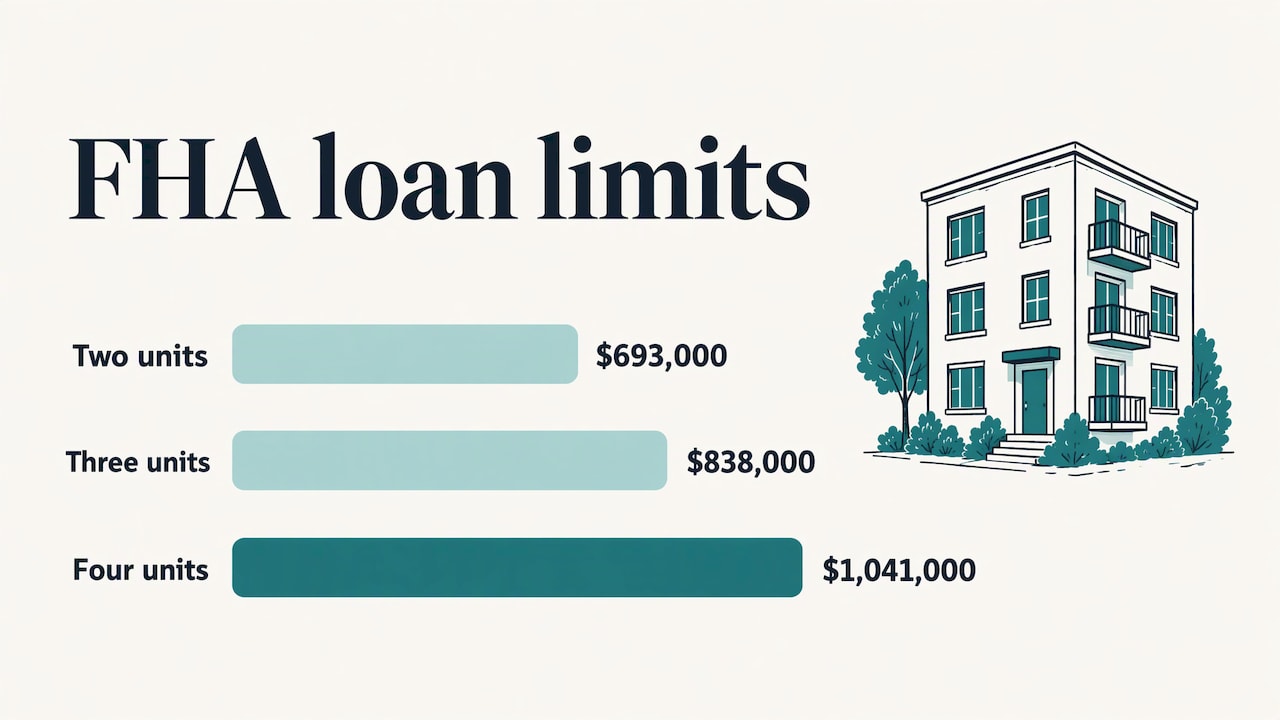
FHA loan-limit floors for 2026 are roughly $693,000 for two units, $838,000 for three and $1,041,000 for four. FHA charges a 1.75% upfront mortgage insurance premium and, for most 30-year minimum-down loans, an annual premium of 0.55% (AmeriSave). Add those to your monthly payment before you decide what you can afford.
Counting rent toward qualifying
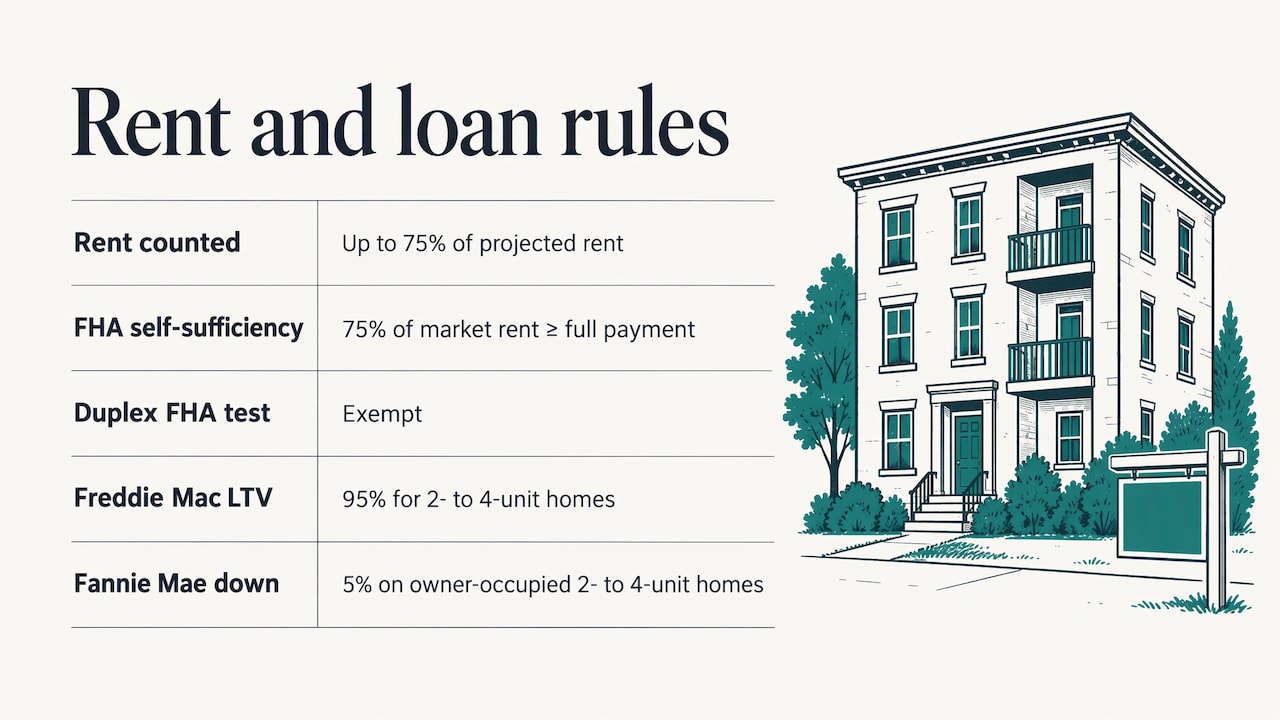
Lenders can count up to 75% of projected rent toward qualifying (LendingTree). The 25% haircut allows for vacancy and upkeep.
FHA applies a self-sufficiency test to 3- and 4-unit properties. Seventy-five percent of the appraiser’s market rent for all units, including yours, must equal or exceed the full monthly payment. Duplexes are exempt. In one worked example, a $600,000 triplex with $1,900 rents falls short by $761 a month (First Home Buyers). Run this test before you fall in love with a triplex.
Conventional rules are moving too. Freddie Mac raised its maximum loan-to-value on 2-unit and 3- to 4-unit primary residences to 95%, effective September 29, 2025. Fannie Mae allows 5% down on owner-occupied 2- to 4-unit properties (First Home Buyers). Fannie Mae’s new rental income rules apply to applications from December 1, 2026 (Make Massachusetts Your Home). Ask your lender which version applies to your application.
Cutting the cash you need
Cash is the real barrier for most first-time buyers. Closing costs generally run 2% to 5% of the price (The Close), and lenders want reserves on top of the down payment. This is where assistance programs earn their place. We offer down payment and closing cost assistance, and our guides cover how programs work in Washington, Colorado and Los Angeles County. If zero-down options interest you, start with our no down payment loan guide. To build your own savings first, use our down payment saving plan.
The steps from budget to closing
LendingTree lays out six steps. Here they are, with what to watch at each.
- Set your budget. Count the down payment, closing costs, renovations and potential rent. Include the mortgage insurance and reserves from the table above. The most common error is budgeting only for the down payment.
- Choose a loan and get preapproved. Preapproval tells you which price range and loan type fit. Our guide to getting approved for a mortgage shows what lenders look at. If you are buying for investment, Property Acquisition & Analysis is part of what we do.
- Shop for the property. Compare buildings by the numbers in the next section, and check each against the FHA test if you plan to use that loan. Search the markets where we work: California, Colorado, Washington and Wyoming.
- Make an offer. Base it on a comparative market analysis, which uses comparable recent sales (The Close). Put your inspection and financing contingencies in writing.
- Apply, appraise, inspect. The lender orders an appraisal, and you order inspections. For FHA, the appraiser’s market rent figure feeds directly into qualifying.
- Close and plan management. Allow 30 to 60 days after acceptance. Decide before closing who will manage the building and where the maintenance fund lives.
As your broker, we stay with you through each of these stages. You get personalized guidance rather than a form to fill in, and with our buying and selling services you have one team from search to keys.
Running the numbers before you offer
A building can look great on a listing and lose money. Use a consistent method.
Verify the income
Check rents against current leases and payment history, against comparable units that actually rented, and against a local manager’s estimate (The Money Pocket). The same source shows how much an assumption matters: a $150 monthly rent overestimate cuts modeled cash flow from $202 to $74.
Build net operating income
The National Apartment Association defines effective gross income as potential rent minus vacancy and collection loss, plus other income. Net operating income (NOI) is that figure minus operating expenses, and it excludes mortgage payments and capital reserves (NAA). Expenses to include:
- Property tax and landlord insurance
- Owner-paid utilities
- Management and repairs
- Vacancy allowance
- A capital reserve
Security Bank & Trust suggests 5% vacancy as a starting point for a stabilized property in a steady market, adjusted for local conditions. It adds that management and reserves belong in the model even if you plan to self-manage (Security Bank & Trust). NerdWallet cites 1% to 4% of property value a year for maintenance (NerdWallet).
JPMorgan’s lending team advises relying on the historical actuals of the expense structure, not the broker’s estimate of what expenses could be (JPMorgan). Ask the seller for two years of operating statements.
Three ratios
Subtract annual debt service from NOI to get cash flow. Then compare:
- Cap rate: NOI divided by price.
- Cash-on-cash return: annual cash flow divided by the total cash you put in.
- Debt service coverage ratio (DSCR): NOI divided by debt service.
Then stress-test lower rents, higher vacancy, higher expenses and a different interest rate (The Money Pocket).
Where the 1% rule fits
The 1% rule says monthly rent should be at least 1% of the price. Treat it as a quick filter only. In The Money Pocket’s example, a property passes at 1.07% and still produces just $202 a month in cash flow. National figures show how rare the pass has become: one analysis of 2024 Census data found no state at the 1% threshold, with a national ratio of 0.41% (CrowdfundedWealth). If you apply the rule strictly, you will find few listings, and the ones you do find may hide problems.
Inspection and reserves
JPMorgan frames the review in three parts: the building (units, condition, sales history), the location (vacancy, local policies, environmental risk) and the finances, with a rule of thumb of setting aside 1% of value a year for maintenance (JPMorgan). U.S. Bank adds that major items such as roofs and mechanical systems belong in your cost assumptions (U.S. Bank). When one of those comes due, financing a roof, siding or window project is a cash question you will want answered before closing, not after.
Tax and rent rules that change the math
The One Big Beautiful Bill Act, signed July 4, 2025, permanently restored 100% bonus depreciation for qualifying property placed in service after January 20, 2025. It also raised the Section 179 expensing limit to $2.5 million and made the 20% qualified business income deduction permanent (Landlord Studio). Ask a CPA how these apply to your building.
Rent rules vary by state. Washington has a 10% annual cap for many residential tenants. California limits increases to 5% plus inflation, or 10%, whichever is less, for properties at least 15 years old, and requires 30 days’ notice for increases up to 10% and 90 days above that (Landlord Studio). Model your rent growth inside those limits, not above them.
If you later sell one investment property to buy another, 1031 exchanges can defer the tax. Plan for it before you list, not after.
Which market to buy in
Identical buildings in different places have very different economics, as U.S. Bank’s Bill Merz points out, and he stresses liquidity to cover vacancies and repairs (U.S. Bank). Compare vacancy, rent levels, local rent rules and property taxes across the metros you are considering. Elevated mortgage rates have kept more households renting, which supports demand for rental housing (NYLIM). We work in Spokane and Seattle-Tacoma, Denver, Los Angeles County and the San Francisco Bay Area, so we can compare those local markets with you directly. Investors buying from another state can use our out-of-state investor support. For more on choosing an agent for this type of deal, read our investment property realtor guide.
What we do about it
We are a commission-based brokerage focused on simplifying the buying and selling process, with lower-cost listings and personalized guidance in California, Colorado, Washington and Wyoming. For a multifamily buyer, that means help with Property Acquisition & Analysis, Out-of-State Investor Support and 1031 Tax Code Exchanges, and for first-time buyers, down payment and closing cost assistance programs. If you are weighing a duplex or triplex, start on our investor page or talk to us through the buying services page.

If you are a trustee selling an inherited multifamily building, our trust services include Valuation & Preparation, Transaction Coordination and Assistance & Guidance.
Our view
Most first-time buyers think of multifamily as an investor’s game. We see it as one of the most practical ways to own a home. One unit is yours and the others help carry the payment.
The risk is in the details. The loan type, the self-sufficiency test, the reserves and the true expense history decide whether the building works, so we want you to see all of them before you write an offer.
Cost matters to us at every step. That is why we focus on lower-cost listings and on down payment and closing cost assistance, so more of your cash goes into the property and your reserves.
Justin
FAQ
Can a first-time buyer purchase a multifamily property?
Yes. A first-time buyer can buy a two- to four-unit property with an owner-occupied loan. FHA allows 3.5% down and conventional allows 5% down (LendingTree). You must live in one of the units.
How much down payment do I need?
It depends on whether you will live there. Owner-occupied purchases can start at 3.5% (FHA) or 5% (conventional), while non-owner-occupied conventional purchases typically need 25% (AmeriSave). Add closing costs of 2% to 5% and your reserves.
Is a duplex easier to finance than a triplex?
Usually, under FHA. Duplexes are exempt from the self-sufficiency test, while triplexes and fourplexes must pass it (First Home Buyers). Loan limits are also lower for two units than for three or four.
How long does it take to close?
The lender-financed process takes about 30 to 60 days after your offer is accepted (The Close). A prompt preapproval and a clean set of documents help you stay within that range.
Sources
- BiggerPockets: Multifamily Real Estate Investment Guide
- Chase: Multi-Family Homes: What to Know Before Buying
- AmeriSave: Buying a Multifamily Home in 2026
- LendingTree: Buying a Multifamily Home
- The Close: How to Buy a Multifamily Property
- NerdWallet: What to Know About Buying an Investment Property
- First Home Buyers: House Hacking 2026
- Make Massachusetts Your Home: Multifamily Mortgages
- The Money Pocket: How to Analyze a Rental Property
- National Apartment Association: CAM Financial Terms and Formulas
- Security Bank & Trust: How to Estimate Rental Property Cash Flow
- CrowdfundedWealth: Rental Property Calculator
- JPMorgan: What to Look for When Buying Multifamily Property
- U.S. Bank: How to Buy an Investment Property
- Landlord Studio: 2025-2026 Real Estate Market Report
- NYLIM: Locked In
- Revive Exteriors: Financing Your Roofing, Siding, or Window Project